
Q: What Are Perfect Squares and Perfect Cubes?
A: Discovering Patterns: Perfect Squares, Perfect Cubes, and the Beauty of Mathematics
Have you ever noticed how numbers can have a hidden rhythm and harmony? Understanding these patterns can make mathematics not just easier, but genuinely fascinating. Two fundamental concepts that showcase this beauty are perfect squares and perfect cubes. Let’s explore them in a simple and intuitive way.
There is a certain uniformity in these patterns, and it is this very uniformity that creates beauty. Mathematics, in many ways, is a lens through which we can perceive order and elegance in the world. Learning about perfect squares and perfect cubes is a small but significant step toward recognising the aesthetic patterns hidden in numbers.
And it’s not just numbers. The beauty we see around us—in nature, architecture, and art—is often a reflection of the same mathematical uniformity. From the petals of a flower to the proportions of a building, the world follows patterns that mirror the harmony found in mathematics.


1. Perfect Squares
A perfect square is a number that can be expressed as the product of an integer with itself. In other words, if you multiply a number by itself, the result is a perfect square.
Formula:
\[\text{Perfect Square} = n \times n = n^2
\]
Here, n is any integer.
Examples:
- \[1 \times 1 = 1\] → 1 is a perfect square
- \[2 \times 2 = 4\] → 4 is a perfect square
- \[3 \times 3 = 9\] → 9 is a perfect square
- \[10 \times 10 = 100\] → 100 is a perfect square
Tip to Remember:
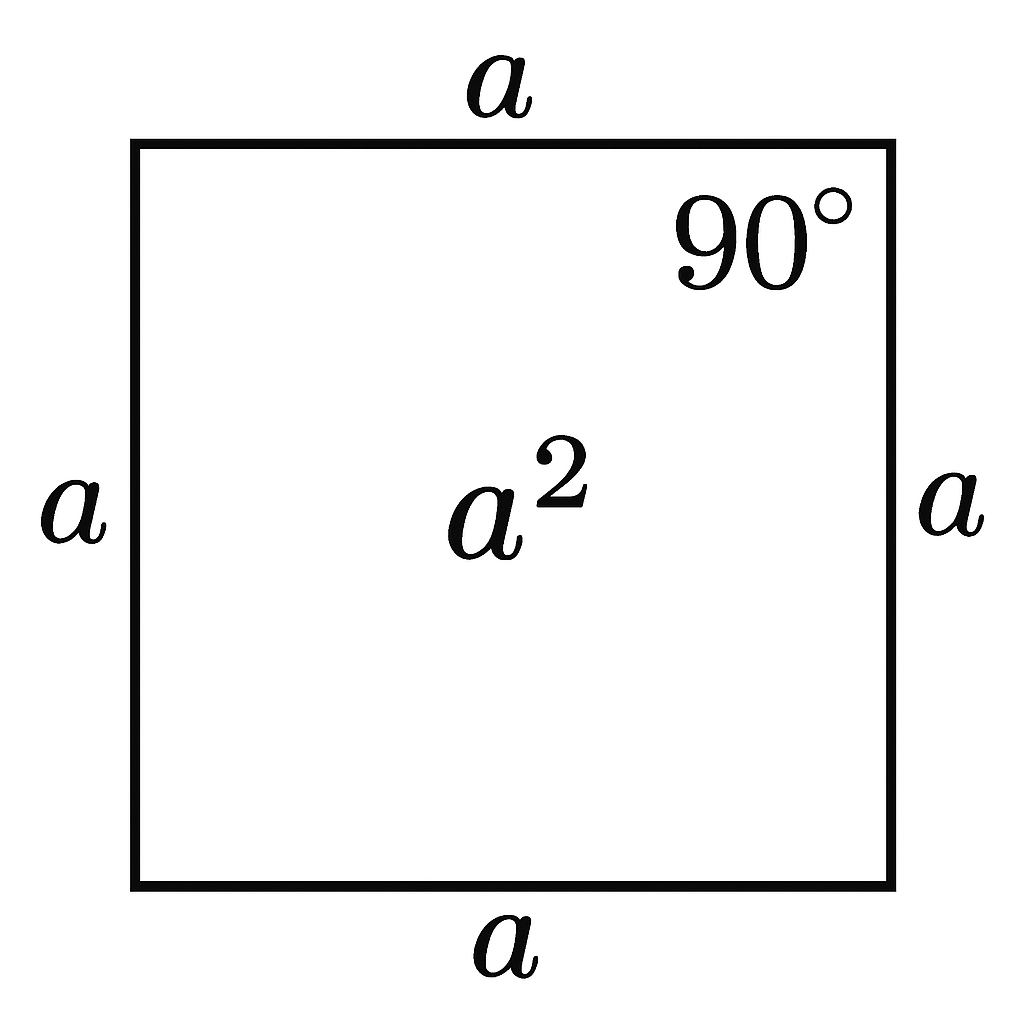
Think of a perfect square as forming a square shape. For example, if you have 9 dots, you can arrange them in a perfect 3×3 square. That’s why it’s called a perfect square.
Shown in the figure is a perfect square, and each side has a length of a.
2. Perfect Cubes
A perfect cube is a number that can be expressed as the product of an integer multiplied by itself three times. Essentially, if a number is used as the length, breadth, and height of a cube, the result is a perfect cube.
Formula:
\[\text{Perfect Cube} = n \times n \times n = n^3
\]
Here, n is any integer.
Examples:
- \[1 \times 1 \times 1 = 1\] → 1 is a perfect cube
- \[2 \times 2 \times 2 = 8\] → 8 is a perfect cube
- \[3 \times 3 \times 3 = 27\] → 27 is a perfect cube
- \[4 \times 4 \times 4 = 64\] → 64 is a perfect cube
Quick Comparison Table
| Concept | Formula | Example Numbers | Shape to Imagine |
|---|---|---|---|
| Perfect Square | \[n^2\] | 1, 4, 9, 16, 25 | Square (2D) |
| Perfect Cube | \[n^3\] | 1, 8, 27, 64, 125 | Cube (3D) |
Why Learning Perfect Squares and Cubes is Important
- Quick calculations: They help in mental math and solving problems faster.
- Algebra: They are foundational in learning quadratic and cubic equations.
- Geometry: Perfect squares and cubes help in understanding area and volume.
- Number patterns: Recognising these numbers improves logical thinking.
First 50 Perfect Squares and Cubes
| n | Perfect Square (n²) | Perfect Cube (n³) |
|---|---|---|
| 1 | 1 | 1 |
| 2 | 4 | 8 |
| 3 | 9 | 27 |
| 4 | 16 | 64 |
| 5 | 25 | 125 |
| 6 | 36 | 216 |
| 7 | 49 | 343 |
| 8 | 64 | 512 |
| 9 | 81 | 729 |
| 10 | 100 | 1000 |
| 11 | 121 | 1331 |
| 12 | 144 | 1728 |
| 13 | 169 | 2197 |
| 14 | 196 | 2744 |
| 15 | 225 | 3375 |
| 16 | 256 | 4096 |
| 17 | 289 | 4913 |
| 18 | 324 | 5832 |
| 19 | 361 | 6859 |
| 20 | 400 | 8000 |
| 21 | 441 | 9261 |
| 22 | 484 | 10648 |
| 23 | 529 | 12167 |
| 24 | 576 | 13824 |
| 25 | 625 | 15625 |
| 26 | 676 | 17576 |
| 27 | 729 | 19683 |
| 28 | 784 | 21952 |
| 29 | 841 | 24389 |
| 30 | 900 | 27000 |
| 31 | 961 | 29791 |
| 32 | 1024 | 32768 |
| 33 | 1089 | 35937 |
| 34 | 1156 | 39304 |
| 35 | 1225 | 42875 |
| 36 | 1296 | 46656 |
| 37 | 1369 | 50653 |
| 38 | 1444 | 54872 |
| 39 | 1521 | 59319 |
| 40 | 1600 | 64000 |
| 41 | 1681 | 68921 |
| 42 | 1764 | 74088 |
| 43 | 1849 | 79507 |
| 44 | 1936 | 85184 |
| 45 | 2025 | 91125 |
| 46 | 2116 | 97336 |
| 47 | 2209 | 103823 |
| 48 | 2304 | 110592 |
| 49 | 2401 | 117649 |
| 50 | 2500 | 125000 |
Conclusion:
Perfect squares and perfect cubes are simple concepts once you visualise them. Squares relate to multiplying a number by itself, forming a 2D square. Cubes relate to multiplying a number three times, forming a 3D cube. With practice, you’ll start spotting them instantly in mathematics.